


Before you dive into tweaking TV settings, take a moment to play detective in your own living room. Glare can come at you from surprising angles, so pinpointing the real culprit will save you time and frustration later.
Pinpointing the Source Of TV Glare
Spend a few evenings watching your favorite show and note exactly when that blinding wash shows up. Is it around sunrise, in the heat of afternoon, or during that cozy evening glow? This simple tracking habit reveals whether you’re dealing with direct sunlight, ambient room lighting, or reflections off walls.
-
Direct Sunlight: East- or west-facing windows unleash powerful beams.
-
Overhead Lighting: Ceiling fixtures or ornate chandeliers often create hot spots.
-
Reflective Surfaces: Pale walls, glossy floors, even decorative mirrors can bounce light right back at your screen.
Here’s a quick reference to help you match glare sources with solutions:
Quick Guide to Diagnosing and Solving TV Glare
Use this table to quickly match the source of your TV glare with the most direct and effective solution to try first.
| Source of Glare | Common Scenario | Recommended First Action |
|---|---|---|
| Direct Sunlight | TV opposite a large south-facing window | Close blinds or install shades |
| Overhead Lighting | Bright ceiling light directly above | Swap bulbs for lower-lumen LEDs |
| Reflective Surfaces | Glossy tiles or metallic decor nearby | Move TV away or add a rug |
| Side Lamp Reflection | Floor lamp angled toward screen | Reposition lamp or use a lamp shade |
Keep this guide handy as you walk around your room – it’ll point you to the simplest fix first, so you spend less time adjusting and more time enjoying the show.
Matching Light Sources To Solutions
Once the pattern in your space is clear, it’s all about targeted tweaks. For instance, if your TV turns into a mirror every afternoon, that’s a telltale sign the sun’s angle—not your picture mode—is the problem.
Light bouncing off smooth surfaces can boost glare by 15% on average, even under normal indoor lighting.
Ambient bulbs with a warm glow often hit screens at odd angles. Switching to cooler-temperature, lower-lumen LEDs can calm those hotspots instantly.
Reflections from pale walls or glass frames can be trickier. A quick furniture shuffle or a pair of darker curtains can cut off those sneaky light paths.
You might even keep a short log—jot down when and where glare appears over three days. You’ll uncover trends you might’ve missed just watching TV.
If direct sunlight refuses to quit, later we’ll dive into residential and commercial window-tinting options perfect for Chattanooga homes and businesses.
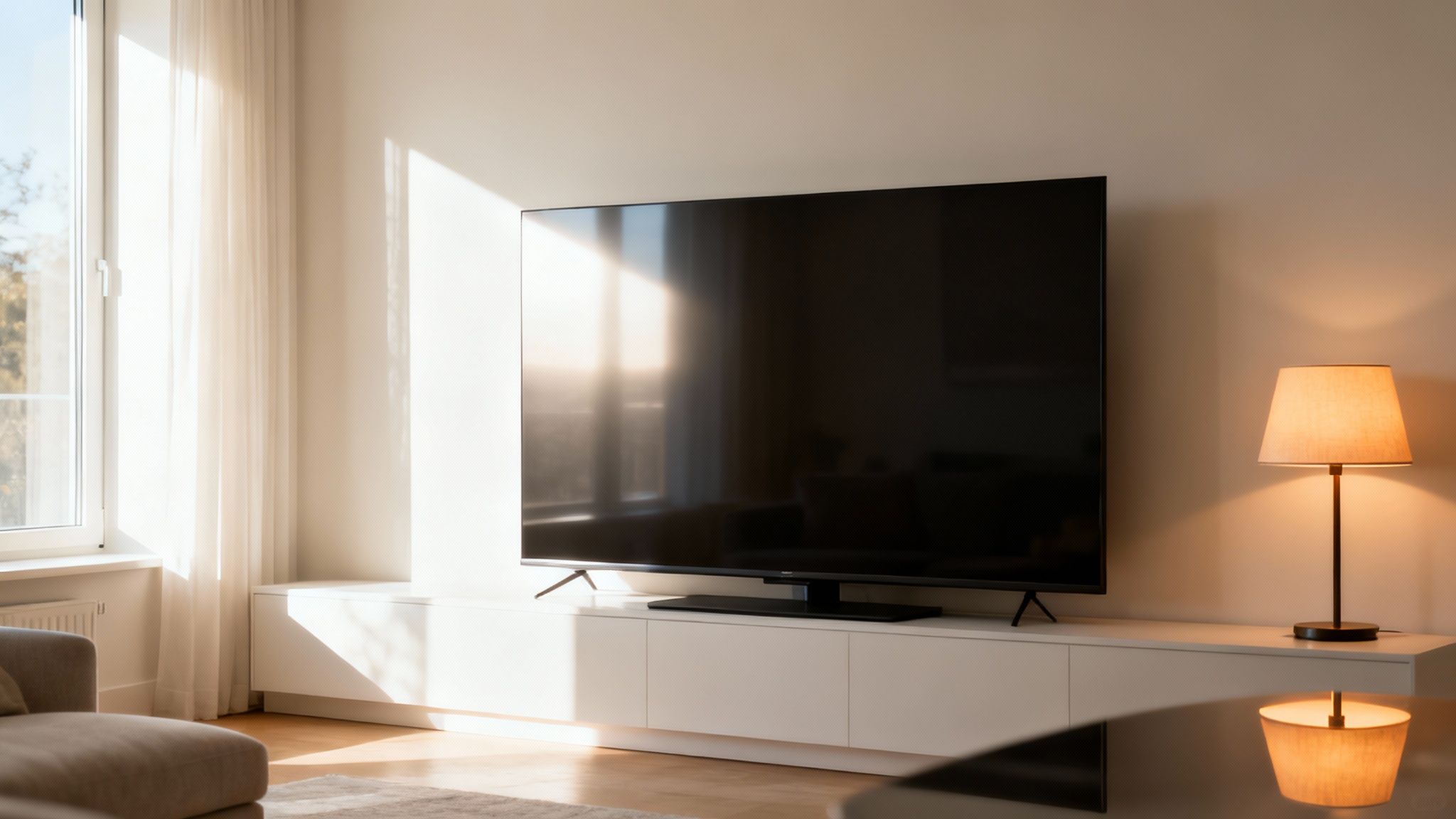
Quick Fixes for Instant Glare Relief
You don't always need to pull out the big guns to fight TV glare. Sometimes, the best fixes are the simplest ones—quick adjustments that cost you nothing and can make a massive difference in just a few minutes. Let's dive into the low-hanging fruit of glare reduction.
The first thing to look at is your TV's position. If it’s mounted on the wall, even a tiny change in its angle can be a game-changer. Most modern TV mounts are built for exactly this kind of problem.
Tweak Your TV's Position
A tilting TV mount is your best friend against glare from overhead lights. By angling the screen down just a few degrees, you can bounce that reflection away from your eyes. It’s a simple move that often gets rid of those annoying bright spots from can lights or ceiling fans completely.
Got a pesky floor lamp causing trouble from the side? This is where a full-motion mount really shines. It lets you swivel the TV left or right, dodging the reflection without having to shuffle all your furniture around.
If your TV is on a media console, it's even easier. Try sliding it a few inches to one side or turning it slightly. You’d be surprised how often a small shift is all it takes to move the screen out of a direct light path.
I’ve found that shifting your viewing angle by as little as 10 to 15 degrees can be enough to make a direct reflection vanish. It's a powerful first step everyone should try.
Rearrange the Room (Just a Little)
Beyond just moving the TV, take a look at what’s around it. A strategically placed piece of furniture or even a plant can act as a natural light blocker. Get creative and think about how you can stop the light before it even hits the screen.
Here are a few instant-relief ideas I recommend to clients:
-
Move That Floor Lamp: Is a tall lamp off to the side casting a perfect circle of glare on your screen? Just move it behind your couch. It will still light up the room but won't be in the reflection zone.
-
Shut an Interior Door: Light pouring in from a bright kitchen or hallway is a sneaky source of glare. It's an obvious fix, but one we often forget in the moment.
-
Bring in a Tall Plant: A big houseplant, like a Fiddle Leaf Fig, placed next to a window can block that harsh angled sunlight without making the whole room dark. Plus, it looks great.
-
Adjust Your Seat: Honestly, sometimes it’s easier to move yourself than the TV. Shifting your favorite chair a foot or two can completely change your viewing angle and make the glare disappear.
These adjustments are the easiest wins you'll get. They put you in control of your viewing environment right away. For homeowners and business owners here in the Chattanooga area, these small tweaks are the perfect place to start before thinking about bigger solutions. A little experimenting often leads to a quick and very satisfying fix.
Managing Natural Light with Window Treatments
When you’ve tried all the quick fixes like rearranging the furniture, it’s time to go to the source: your windows. They’re the biggest culprit for daytime TV glare. The goal here isn’t to turn your living room into a cave, but to get smart about controlling the sunlight that comes pouring in.
The right window treatments put you in the driver's seat, letting you dial in the perfect amount of light no matter the time of day. Before you spend a dime, though, a few simple tweaks can make a surprising difference.

As you can see, sometimes all it takes is a slight tilt of the screen or shifting a lamp to get immediate relief from those distracting reflections.
Curtains, Blinds, and Shades Explained
For a lot of folks here in the Chattanooga area, curtains are the first thing that comes to mind. And for good reason.
Blackout curtains are fantastic if you’re building a dedicated home theater. They'll completely kill the incoming light for that true cinema vibe. But for casual daytime viewing, they can make a room feel a bit too dark and closed-off.
A more practical middle ground is light-filtering curtains. These are great because they soften that harsh, direct sunlight and cut down on glare without sacrificing all the natural light you love.
Blinds and shades, on the other hand, give you more fine-tuned control. They let you adjust the angle and amount of light with surgical precision.
-
Cellular Shades: These are champs at insulation and you can get them in light-filtering options that knock down glare while keeping the room bright and airy.
-
Vertical or Horizontal Blinds: The classic, versatile choice. A quick flick of the wand can redirect sunbeams away from your TV, offering an instant solution as the sun moves across the sky.
The best window treatments don't just solve one problem. They should cut the glare, protect your privacy, and match your home's style—all while letting you enjoy that beautiful Tennessee sunshine on your own terms.
Finding the Right Balance for Your Space
Every room has its own personality and its own challenges. A living room with huge, south-facing windows is going to have different needs than a home office where you need to see your screen clearly for video calls.
It all comes down to finding a solution that fits your life. Are you trying to block light completely for Friday movie nights, or just take the edge off the intense afternoon sun?
For anyone looking for a more permanent and high-performance fix that doesn’t mean covering up your windows, it's worth exploring all the options. You can learn more about how window tinting can improve livability in your home in our detailed guide. It's the perfect next step for tackling glare head-on while keeping your view.
A Permanent Fix with High-Performance Window Film
While messing with blinds and shifting furniture around can help in a pinch, these are just band-aids. They force a trade-off: you either put up with the annoying glare or you plunge your room into darkness, losing all that beautiful natural light that makes a space feel alive.
If you’re looking for a real, permanent solution that tackles glare right at the source without forcing you to live in a cave, high-performance window film is the answer. Period.
This isn’t the purple, bubbly tint you sometimes see on older surfaces. Today’s residential and commercial window films are seriously advanced pieces of tech, engineered with multiple layers to intelligently filter sunlight. They zero in on the specific light wavelengths causing the problems, letting all the good, visible light stream through.
The Power of Nano-Ceramic Technology
Leading the charge is nano-ceramic film, the very same solution we specialize in for homes and businesses in our 45-60 mile radius around Chattanooga, TN. Unlike old-school dyed or metallic films, nano-ceramic films are infused with microscopic ceramic particles. You can't see them, but they are incredibly powerful.
These tiny particles are masters at absorbing and rejecting solar energy. In real-world terms, this means they can slash the intensity of direct sunlight and cut harsh glare by over 85% in most situations. The result? A crisp, clear view of your TV, even on a blazing Tennessee afternoon, without ever touching the curtains.
The best part? High-performance films pull this off while staying virtually invisible. You keep your stunning view and get to enjoy soft, filtered natural light all day long.
It’s Not Just About Glare
The perks of professional window tinting go way beyond making your TV-watching better. Think of it as a complete upgrade for your property—an investment that pays dividends in comfort, protection, and even your utility bills.
The same technology that kills glare is also a beast when it comes to blocking other nasty parts of solar radiation.
-
UV Ray Protection: Our films block 99% of damaging UV rays. These are the rays responsible for fading your hardwood floors, furniture, rugs, and artwork. Your valuables are protected for years to come.
-
Solar Heat Rejection: By blocking a huge chunk of the sun’s infrared heat, window film helps keep your home or office much cooler in the summer. Your AC unit gets a break, and your energy bills can drop.
-
Enhanced Comfort: Say goodbye to those annoying hot spots right next to the windows. The temperature in your rooms becomes more consistent and comfortable, whether it’s your living room or a commercial storefront.
People are catching on. The market for anti-glare film is booming, with projections showing it will hit $20.28 billion by 2029. This isn't just a niche product anymore; it's driven by real people wanting more comfortable and usable spaces. You can dig into the numbers and see how it's impacting North America in the full market research report.
A Smart Investment for Chattanooga Properties
For anyone owning property here in the Chattanooga area, installing professional window film just makes sense. It’s a practical, long-term fix for the intense sun we get, which is the root cause of both uncomfortable rooms and that maddening screen glare.
Unlike temporary fixes you have to fuss with every day, this is a one-and-done installation that delivers benefits 24/7, all year round.
The process itself is quick and clean, handled by certified installers who guarantee a perfect, bubble-free finish. If you’re curious to learn more about the different types of films available and how they work in different situations, our ultimate guide explains how window tinting can transform your home and business. It’s truly the best way to solve your TV glare problem for good.
Applying an Anti-Glare Screen Protector
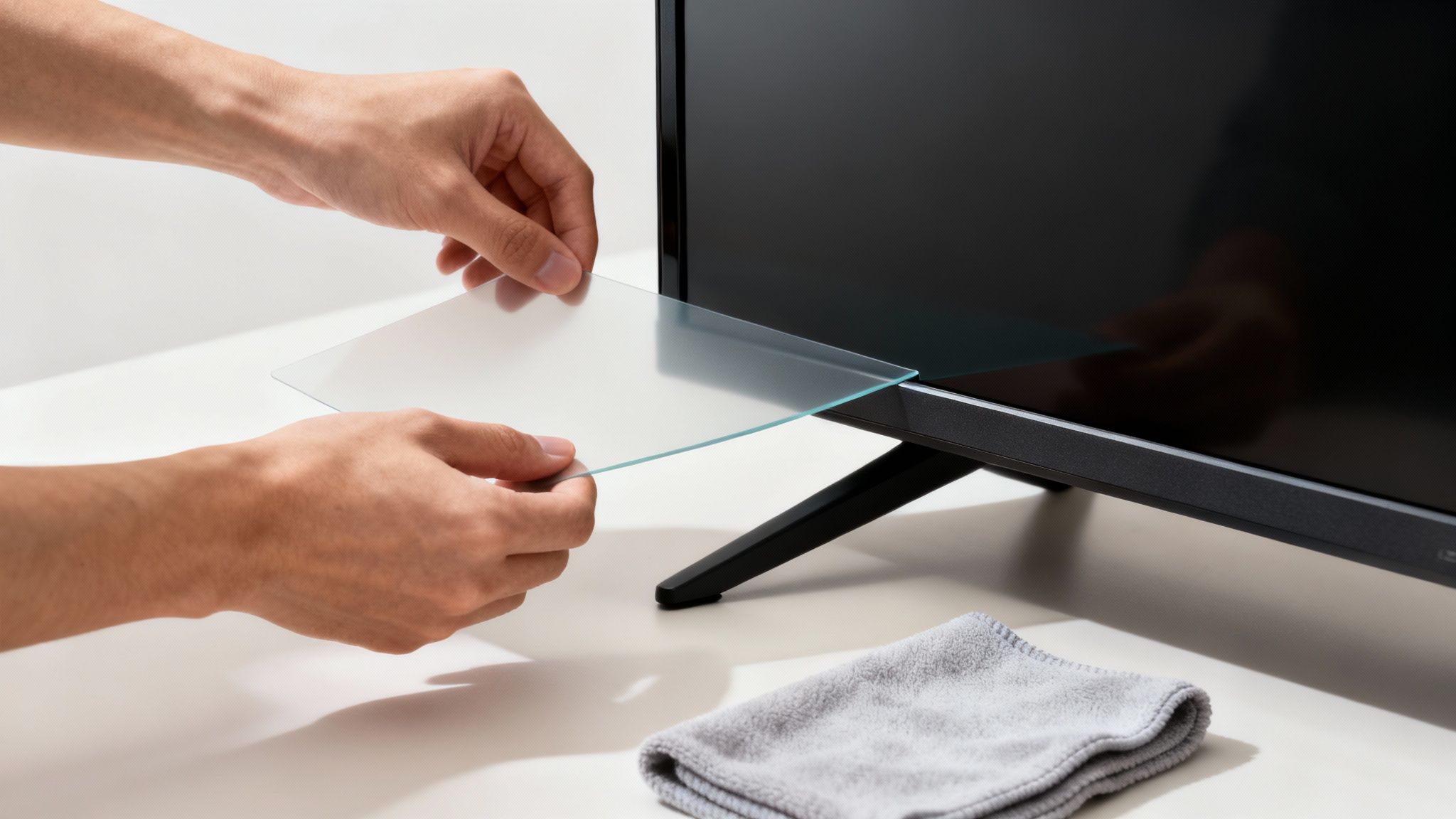
If you're not looking to make permanent changes to your windows, taking the fight directly to the source—your TV screen—is an incredibly effective move. An anti-glare screen protector is a thin film that sticks right onto your screen, engineered specifically to diffuse those annoying light reflections before they ever hit your eyes.
How does it work? Simple: a specialized matte finish. Picture the difference between a glossy photograph and a matte one. The glossy photo acts like a mirror, creating a sharp, blinding reflection. The matte surface, on the other hand, scatters that incoming light in every direction, which softens the reflection into something you barely even notice.
Choosing the Right Protector
Let's be clear: not all screen protectors are created equal. The market is absolutely flooded with options, so you need to know what to look for to get a product that actually works without degrading your picture quality. It's a booming industry—the global market for these protectors hit $2.3 billion in 2024 and is expected to nearly double by 2033 as more people prioritize eye comfort. You can review the market data to see just how big this trend has become.
When you're shopping, keep an eye out for these key features:
-
Material Quality: Go for multi-layered films that boast high light transmittance. The cheap, single-layer options can often leave your screen looking hazy, which defeats the whole purpose.
-
Proper Sizing: This is crucial. Measure your TV screen's diagonal length and double-check it against the protector's specs. A protector that doesn't fit right looks sloppy and makes installation a nightmare.
-
Ease of Application: The good ones come in a kit with everything you need, like a small squeegee and a microfiber cloth. These tools are essential for getting a smooth, bubble-free finish.
A common trade-off with some anti-glare protectors is a slight reduction in picture sharpness. High-quality films minimize this effect, but it’s a factor to consider, especially for 4K or 8K TVs where every pixel counts.
Installation Tips for a Flawless Finish
Applying a massive screen protector can feel a little intimidating, but the secret is patience. Your biggest enemy here is dust, since even one tiny speck can create an infuriating air bubble.
Start by giving your TV screen a thorough cleaning with a lint-free cloth. I'd recommend doing this in a room that's well-lit so you can spot any stray dust, but not so bright that you're fighting glare while you work.
When you're ready to apply the film, begin at one edge. Slowly and carefully smooth it across the screen using a squeegee or even a credit card. As you go, push any air bubbles toward the nearest edge. Take your time, and you'll get it right.
Answering Your Top TV Glare Questions
We've walked through a lot of ways to tackle glare, from rearranging the living room to installing high-tech window film. But I find people often have a few specific questions that pop up. Let's clear the air on some of the most common ones I hear.
A big one is whether the TV itself makes a difference. Absolutely. Newer OLED screens are generally better at handling reflections than older LCD or plasma TVs because of the way their pixels light up individually. That said, even the most expensive screen on the market will struggle against a direct beam of sunlight.
The screen's finish is another huge factor. Glossy screens can deliver incredible contrast and deep, rich blacks, but they're basically mirrors in a bright room. A matte screen is designed specifically to scatter reflections, but the trade-off can sometimes be a slightly softer, less "punchy" image.
Can I Just Crank Up My TV’s Brightness?
This is the go-to "quick fix" for a lot of people, but honestly, it's a terrible long-term solution. Sure, blasting the brightness can overpower some minor glare for a moment, but you're creating bigger problems.
For one, it completely butchers the picture quality. Colors get washed out, and you lose all the detail in the dark parts of the scene—not what the director had in mind. Plus, you're forcing the TV to work overtime, which shortens its lifespan and drives up your electricity bill. It’s a brute-force approach that just isn’t worth the sacrifice. A much better first move is always to manage the light in the room.
Trying to fix glare by maxing out the brightness is like trying to shout over loud music at a party. You might make yourself heard, but you're not having a quality conversation. It’s much smarter to just turn the music down.
Will Professional Window Tinting Make My Room Too Dark?
This is probably the single biggest myth I have to bust, especially for folks here in sunny Chattanooga. The window films we have today are nothing like the dark, bubbly tint you might be thinking of. High-performance residential and commercial films, particularly modern nano-ceramic options, are incredibly smart. They're engineered to be selective about what they block.
They can cut glare by over 85% and filter out 99% of damaging UV rays, all while being nearly invisible to the naked eye. You keep all that beautiful, natural light that makes your home feel alive, but you lose the harsh glare and heat. It’s the best of both worlds—solving the problem without creating a cave. It’s not about blocking light; it’s about controlling it.
Ready to solve your TV glare problem for good without losing your beautiful view? Solar Sentinel Window Films & Tinting offers premium nano-ceramic window film solutions for homes and businesses throughout the Chattanooga area. Get a free, no-obligation quote today and see how much more comfortable your space can be.
Article created using Outrank
