


Go ahead and search for "tint laws Tennessee," and you'll find page after page of rules for cars. But what about your house or business? While there aren't specific state laws that can hit you with a fine for residential or commercial window tint, the core ideas behind managing light, heat, and reflection are incredibly important for property owners right here in the Chattanooga area.
The real key is understanding how high-performance window film can make your home or commercial space more comfortable and efficient, especially with those colder winter months just around the corner. This guide is designed to educate our local market on the incredible, year-round benefits of professional window tinting.
A Homeowner’s Guide To Tennessee Tint Principles
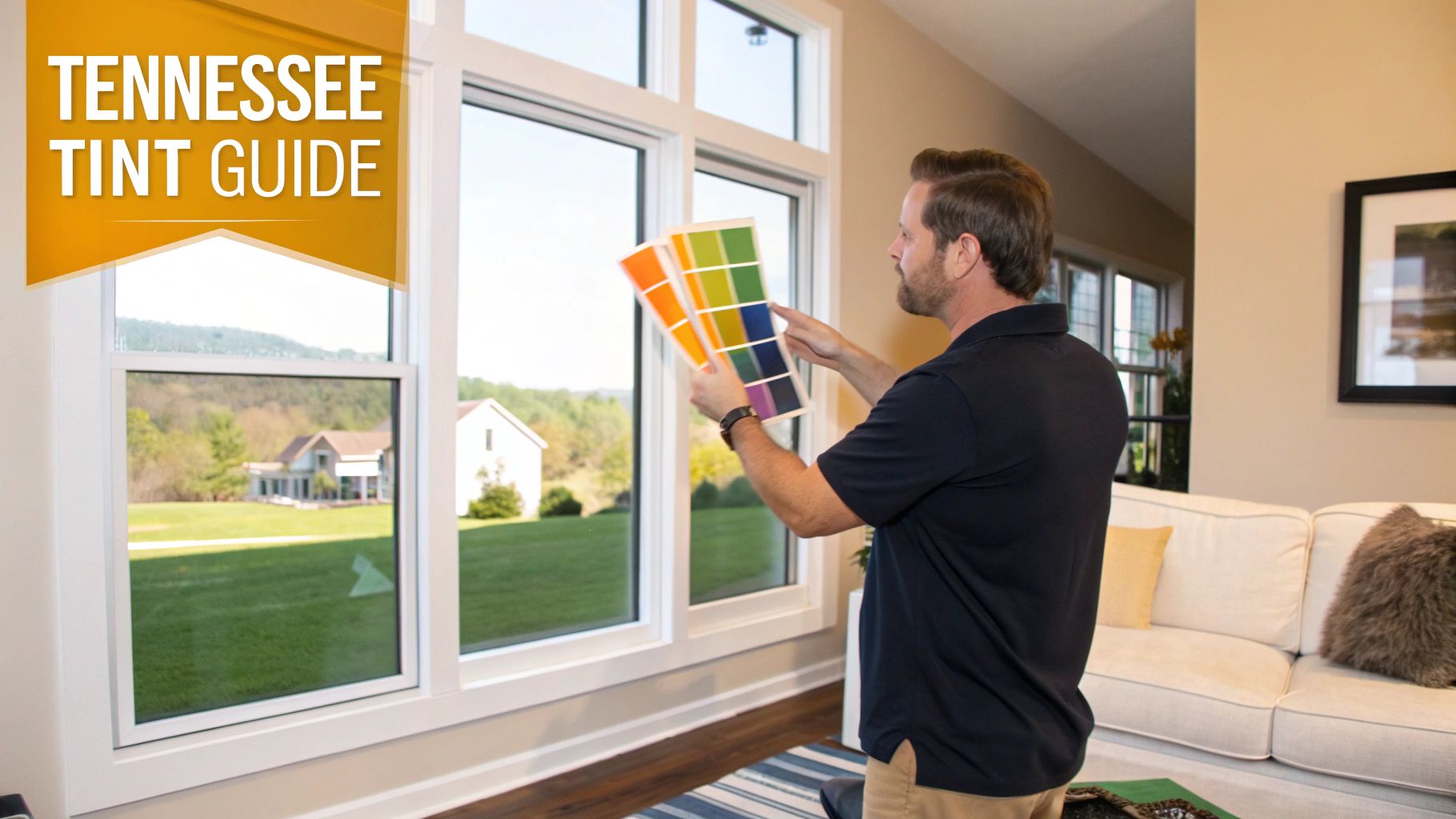
Even though "tint laws tennessee" brings cars to mind, homeowners and business owners can actually learn a ton from the science behind it. For your property, a term like Visible Light Transmission (VLT) isn't about avoiding a ticket; it's about getting exactly what you want out of your living or working space. Instead of being a legal limit, VLT becomes a powerful tool you can use to customize your environment.
Think of it like this: the same type of technology that helps manage solar energy is even more effective at protecting your home or business. High-quality residential and commercial window film acts like a smart gatekeeper for your windows, deciding exactly what gets in and what stays out.
Translating Tint Concepts For Your Property
Getting a handle on how window film really works is the first step toward a smarter, more comfortable property. The focus shifts from just following rules to gaining strategic benefits that make a real-world difference, especially as we head into the winter season in Chattanooga and the surrounding communities.
Here’s how the main ideas from tinting apply directly to your house or commercial building:
- UV Ray Blockage: This is crucial for protecting your assets. The film shields your hardwood floors, furniture, merchandise, and artwork from the sun's fading effects. Professional films block over 99% of damaging UV rays.
- Glare Reduction: Just as tint cuts down on sun glare, it can make watching TV in your living room or working on a computer in an office far more comfortable. It eliminates that harsh light without making the room feel like a cave.
- Energy Efficiency: This is where the winter benefits really kick in. In the summer, film rejects solar heat. But in the winter, it acts as an insulator, helping to trap the heat your furnace is already producing inside your property.
This insulating property is a game-changer for homeowners and businesses within a 45-60 mile radius of Chattanooga. By reducing how much heat escapes through your windows, a professional film installation can lead to real, noticeable savings on your heating bills during the colder months.
Why Winter Comfort Starts With Your Windows
When the temperature drops, untreated windows quickly become the biggest source of energy loss in a building. You can literally feel it as cold spots or drafts when you stand nearby. This is exactly where modern window film technology makes a powerful impact.
It helps create a much more stable and comfortable indoor climate, which means your heating system doesn't have to work nearly as hard.
A professional consultation is the absolute best way to explore these benefits. We can walk you through the options and help you choose the perfect film for your specific goals—whether it's slashing energy costs, protecting your interiors, or simply making your property a more pleasant place to be all year long. It's not about following laws; it's about making a smart investment in your property.
Why Winter Is The Best Time For Window Tinting
Most people in the Chattanooga area only think about window tint when the summer sun is absolutely blazing. And sure, window film is a powerhouse for blocking solar heat, but its job isn't over when the leaves start to fall. In fact, winter might just be the smartest, most strategic time to get professional window film installed on your home or business.
The whole game changes in the colder months. Instead of heat rejection, we start talking about heat retention. Think of a high-quality nano-ceramic window film as a high-tech, invisible thermal blanket for your glass. In July, it keeps the sun’s blistering heat out. But in January, it does the reverse—it keeps the precious warm air from your furnace inside where you're paying for it to be.
This insulating effect is a huge win for any property in the Chattanooga area. Windows are almost always the weakest link in your building's defense against the cold, letting a shocking amount of heat escape. Adding a layer of insulating film is a direct counter-attack against that energy waste.
Creating A More Comfortable Winter Haven
Forget the numbers on your energy bill for a second. Winter window tinting just makes your property feel so much better. Untreated windows are notorious for creating those chilly drafts and cold spots that make you crank the thermostat or just abandon that part of the house or office altogether.
Professional window film puts a stop to that by stabilizing the temperature of the glass itself. You’ll notice the difference right away:
- No More Cold Spots: That insulating layer raises the interior surface temperature of the window, getting rid of that awful chill you feel when sitting next to it.
- Consistent Room Temperatures: By stopping heat from leaking out, the film helps keep the temperature much more even from one room to the next.
- Less Strain on Your Furnace: Your heating system won't have to work nearly as hard, which means less wear and tear and a longer life for your HVAC unit.
The bottom line? You get a cozier, more inviting space all winter. You can actually enjoy the view of the frosty Tennessee landscape without the drafts that usually come with it, making every room comfortable no matter how cold it gets outside.
Ideal Conditions For A Flawless Installation
From a purely practical standpoint, winter is the perfect season for the installation itself. The cool, less humid air we get in Tennessee during the fall and winter creates the ideal environment for window film to cure and bond perfectly to the glass.
The application solution we use evaporates more evenly when humidity is low, which leads to a faster, smoother curing process. This means your film sets up with maximum clarity, with none of the lingering haze that can sometimes pop up in the sticky summer months. While tinting is a fantastic step, you can also learn how to reduce drafts coming from your windows this winter for even more comfort.
Scheduling your install during the "off-season" is a pro move. You get immediate savings on your heating bills and set yourself up to be way ahead of the game before the next summer heatwave rolls in. To see the numbers behind it, check out our guide on window films for energy savings. Upgrading your windows in the winter is a forward-thinking investment that pays you back all year long.
How To Choose The Right VLT For Your Home
When you search for "tint laws," you'll find plenty of information, but the core concept behind it—Visible Light Transmission, or VLT—is an incredibly useful tool for homeowners and business owners, too.
Think of VLT as a dimmer switch for your windows. It’s simply a percentage that tells you how much visible light a window film allows to pass through. Understanding this one number is the key to unlocking all the benefits of residential or commercial window film, from slashing energy bills to protecting your beautiful hardwood floors from fading. It’s not about legal limits; it’s about dialing in the perfect atmosphere for every single room.
A lower VLT percentage means the film is darker, letting in less light. This is fantastic for cutting the harsh glare on a TV in the family room or adding a much-needed layer of privacy to a street-facing office. On the flip side, a higher VLT percentage means the film is lighter, allowing more gorgeous natural light to stream in while still blocking 99% of damaging UV rays.
Matching VLT To Your Chattanooga Property's Needs
The "right" VLT isn't a one-size-fits-all number. It really depends on your goals and the unique personality of your home or commercial space. A sun-drenched storefront in Ooltewah is going to have completely different needs than a cozy, north-facing office on Signal Mountain. Your main objective—be it energy savings, glare reduction, or preserving that stunning view—will point you to the perfect film.
For instance, so many of our Chattanooga neighbors want to lower their energy bills, especially when that winter chill sets in. A mid-range VLT film is a great way to add a layer of insulation, trapping precious heat inside without making your rooms feel like caves. That means your heating system doesn't have to work as hard, saving you money and keeping your family or employees comfortable.
This simple chart is a great starting point for thinking about how tint can help you manage your property's climate year-round.
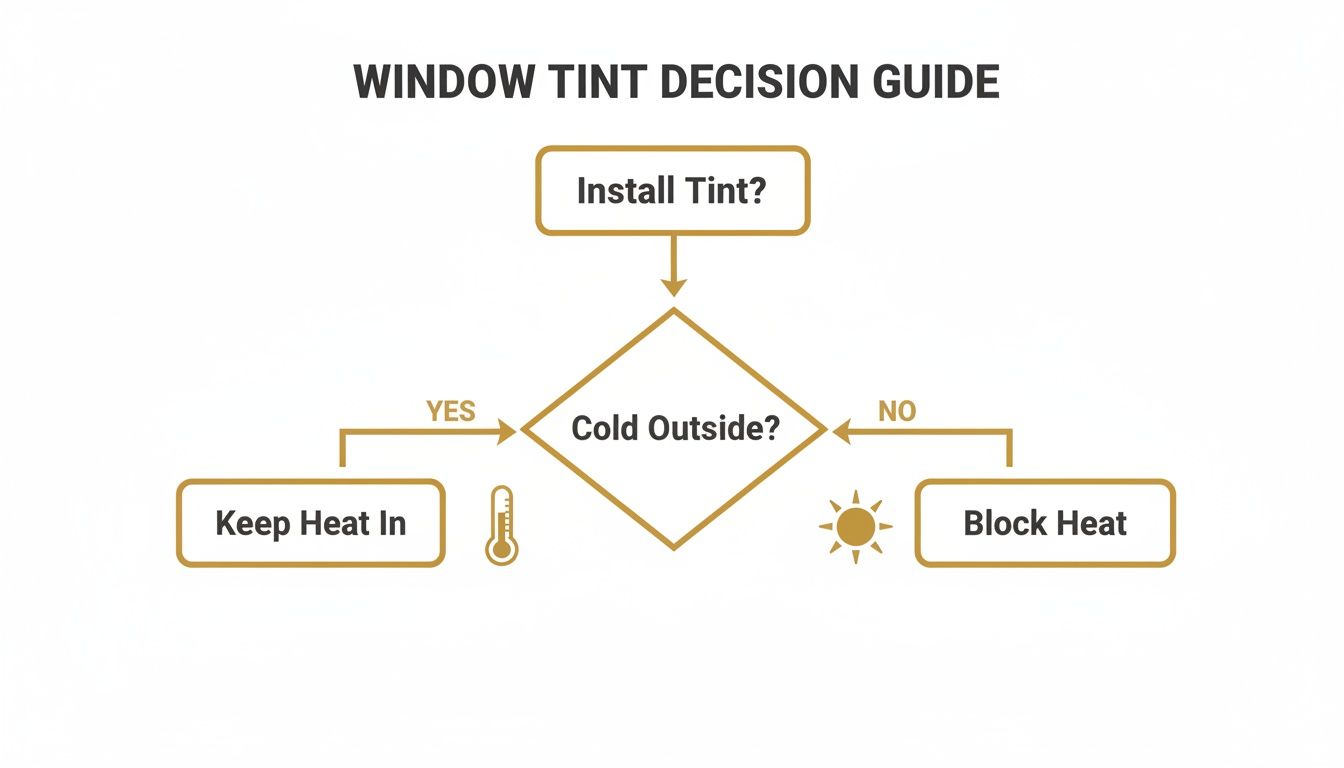
As you can see, whether it's freezing cold or blazing hot outside, installing the right window film is a smart move for controlling your building's temperature and energy consumption.
A Practical Guide To Selecting The Right Film
Let’s put these percentages into real-world scenarios. If your top priority is protecting valuable furniture and artwork from sun damage, you could go with a nearly invisible film that has a very high VLT (think 70% or more). This film would block the invisible UV radiation causing the damage without changing the look of your windows at all.
But what if you have a home office where the afternoon sun makes your computer screen impossible to see? For that, a lower VLT film, maybe in the 20-35% range, would be a game-changer. You'd still get plenty of natural light, but the distracting glare would be gone, creating a much more comfortable and productive workspace. You can learn more about Visible Light Transmission in our deep-dive guide.
The following table can help you connect your specific goals with the right VLT range.
Matching VLT To Your Home's Needs
| Primary Goal | Recommended VLT Range | Best For | Example Application |
|---|---|---|---|
| Max Glare Reduction | 5-20% | Media rooms, west-facing windows | Making a living room TV watchable during the day. |
| Balanced Light & Heat Control | 25-40% | Any room with significant sun exposure | A south-facing kitchen that gets too hot in the summer. |
| Subtle Heat Rejection & UV Block | 50-70% | Rooms where you want to keep the view | Preserving the natural light in a dining room while protecting floors. |
| UV Protection Only | 70%+ | Historic homes, storefronts, any window | Protecting valuable art or merchandise without altering the glass appearance. |
Ultimately, choosing the right film is about finding the perfect balance for your lifestyle and your home.
The beauty of modern window film technology is its incredible versatility. You don't have to choose between a bright, airy space and one that's protected and energy-efficient. You can select a different VLT for every room, fine-tuning the light and comfort to match exactly how you use the space. A professional consultation can help you balance all these needs perfectly.
The Value Of Professional Window Film Installation
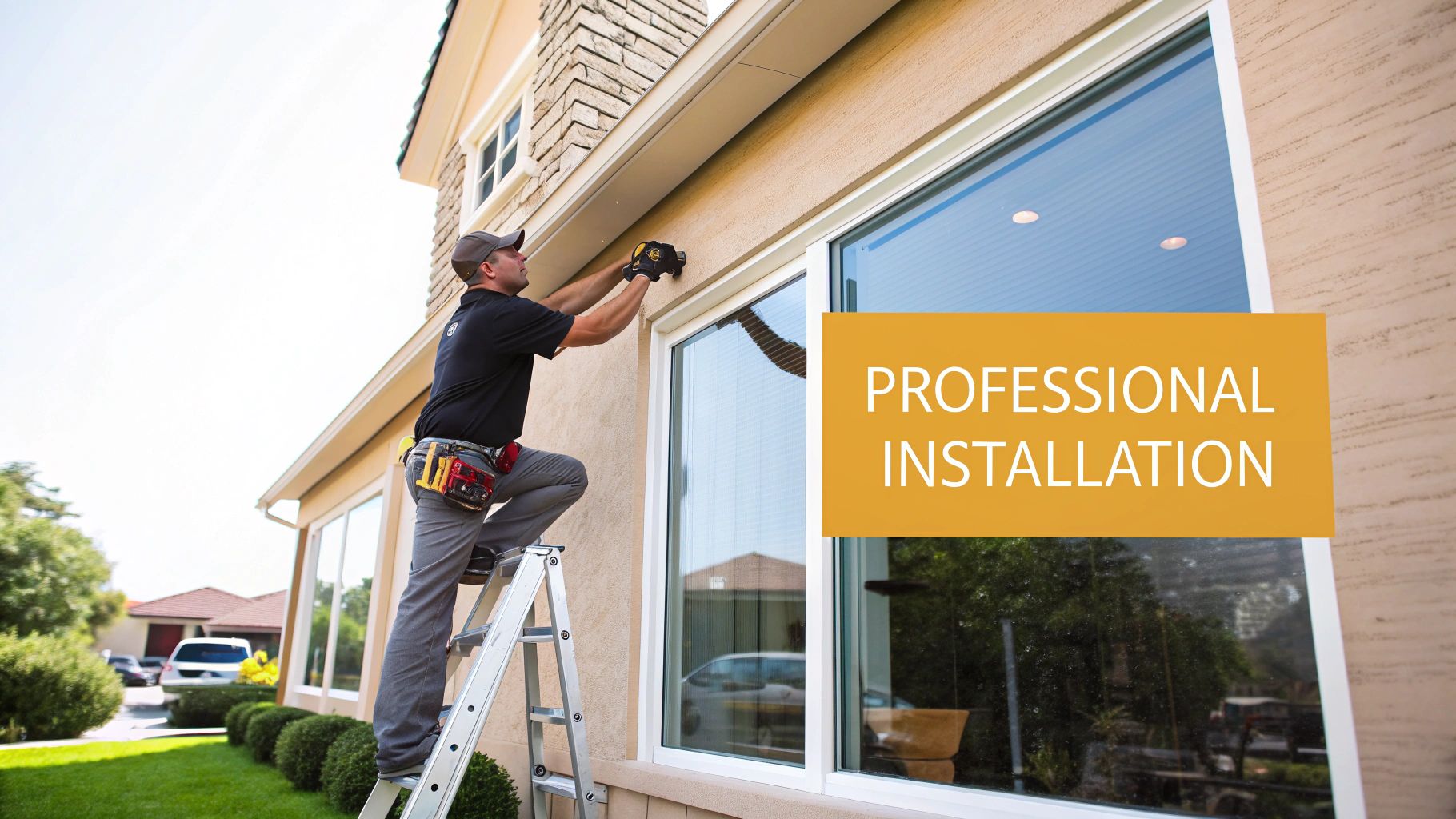
When you look up information on window tinting, you'll find plenty of history on regulations and rules. One of the biggest reasons for these standards was the awful quality of the DIY films from past decades. People got used to seeing tint as a cheap product that would inevitably bubble, peel, and fade to that infamous shade of murky purple.
Thankfully, today's premium films are a completely different animal. But that core lesson still holds true: quality and installation are everything. Choosing a professional for your Chattanooga home or business isn't just a convenience—it's how you guarantee you get the performance and longevity you’re paying for.
The Science Behind Superior Film
So what separates a cheap, off-the-shelf film from a professional-grade product like XPEL nano-ceramic film? It all comes down to some seriously impressive material science.
These films are engineered at a molecular level. Instead of being just a simple sheet of darkened plastic, they're embedded with microscopic ceramic particles that are absolute champs at blocking specific wavelengths of light.
What does that mean for you? It means they can reject a massive amount of solar heat and block over 99% of damaging UV rays without having to be limo-dark. This high-tech approach gives you some huge advantages:
- Durability: Those ceramic particles are incredibly stable. They won’t break down, which means the film holds its color and heat-blocking power for decades.
- Clarity: Unlike old-school metallic films that could mess with your reception, nano-ceramic technology is completely signal-friendly for cell phones and Wi-Fi.
- Efficiency: The film is "spectrally selective," a fancy way of saying it targets the invisible infrared (heat) and UV (fading) rays while letting plenty of beautiful, natural light pour in.
Think of it like this: a cheap film is like putting on a pair of basic sunglasses that just makes everything darker. A nano-ceramic film is more like wearing advanced polarized lenses that specifically eliminate harsh glare and damaging rays, keeping your view crisp and clear.
Why Certified Installation Is Non-Negotiable
Here’s the thing: the world’s best window film is only as good as the person installing it. Getting that flawless, bubble-free application that bonds perfectly to the glass is a skill. It takes training, precision, and the right professional tools.
A certified installer is the only way to get a clean finish that will actually perform as designed. More importantly, working with a certified pro is how you secure a comprehensive lifetime warranty. That’s your protection and peace of mind, right there. Our team is fully trained to make sure every project meets the highest standards, as we detail in our guide to residential window film installation.
The return on this investment is real, and it comes from multiple angles. The initial cost is quickly offset by energy savings all year long. The film acts as an insulator, rejecting heat in the summer and helping keep it inside during the winter. It's a fantastic way to reduce utility bills.
But it's not just about the energy bills. You're also preventing the slow, costly sun damage that fades your floors, furniture, and artwork. A professional installation doesn't just make your home more comfortable—it protects your valuables and ensures you get the maximum return on your investment for years to come.
Busting the Biggest Myths About Home Window Tint
Let's be honest. When you hear "window tint," what’s the first thing that comes to mind? For a lot of folks in Chattanooga, it’s that awful, bubbly purple film you used to see on old buildings or cars. That image has stuck around, and frankly, it gives modern window film a bad rap.
The technology today is on a whole different level. It’s time to clear the air and show you how sophisticated residential and commercial window film is a game-changer for your property.
Myth 1: "Window Tint Will Make My House Feel Like a Cave."
This is easily the biggest fear we hear, and it’s completely understandable if your only reference is old-school dark tint. But it's just not true anymore.
Today’s films are engineered to be spectrally selective. That’s a fancy way of saying they’re smart enough to block the bad stuff—like invisible infrared heat and fabric-fading UV rays—while letting all the beautiful, natural sunlight pour in. You can get powerful heat rejection and block 99% of UV rays with a film that’s so clear, you won’t even know it’s there.
Myth 2: "It's Going to Kill My Houseplants!"
This is another huge one. You've spent years nurturing that fiddle-leaf fig, and you're not about to let window film ruin it. It’s a logical worry: less sun must mean sad plants, right?
Nope! Most common houseplants photosynthesize using the same visible light our eyes see. Since modern films are designed to let that good light through, your green friends will keep on thriving. In fact, the film often helps by softening the harsh, direct sun that can scorch their leaves. It acts like a perfect, gentle filter.
Myth 3: "It’s Just Going to Peel, Bubble, and Fade."
Everyone has seen it—a window that looks like it has a bad case of the chickenpox. That's what happens when you combine cheap, low-grade materials with a sloppy installation. It's a look nobody wants.
This is a problem that professional-grade films have completely eliminated.
Premium products, like the XPEL nano-ceramic films we install, are built with color-stable dyes and incredibly strong adhesives. They are guaranteed not to bubble, peel, crack, or fade. When a certified pro puts them on, they’re backed by a lifetime warranty. We believe in doing it right the first time, which aligns with the importance of meeting statewide tinting compliance standards in any industry.
The difference between a DIY kit from a big-box store and a professional installation is night and day. A certified installation ensures a flawless, edge-to-edge application that bonds securely to the glass, creating a seamless look that lasts a lifetime.
When you get down to it, today’s residential and commercial window films are a high-tech upgrade that offers incredible performance without compromise. By leaving these old myths in the past, Chattanooga property owners can finally enjoy a more comfortable, protected, and energy-efficient space while keeping the bright, beautiful views they love.
Your Top Home Window Tinting Questions, Answered
When Chattanooga property owners start looking into window film, they've usually got a few practical questions. It makes sense. This is an investment in your home or business, and you want to know exactly what you're getting. While many searches for tint laws in Tennessee lead to vehicle rules, the conversation for properties is all about performance, durability, and real-world value.
We hear the same great questions from folks all over the Chattanooga area, so let's clear them up right now.
How Much Can I Really Save On Winter Heating Bills?
This is the big one, especially when you feel that first cold snap. While every home is different, installing a professional insulating film can reduce heat loss through your windows by up to 30%.
What does that really mean? In our Chattanooga climate, it means your furnace doesn't have to fight so hard to keep your home or business comfortable. The heat you're paying for actually stays inside instead of seeping out through the glass. It's like giving your windows a high-tech thermal upgrade without the cost and headache of a full replacement.
Will Window Film Void My Window Manufacturer's Warranty?
This is a fantastic and crucial question. It’s also exactly why you should only work with a certified, professional installer. Here's the deal: top-tier film manufacturers like XPEL provide their own comprehensive warranties that are designed to work alongside your window warranty.
In the rare case that a window seal fails or the glass breaks for a reason tied to the film, XPEL's warranty steps in to cover it. You're protected. A certified pro knows which film is safe for your specific windows (like double-pane or low-e glass) and gives you the paperwork to prove it.
Professional installation completely removes the risk. It’s a guarantee that the right product is used, preserving your window's integrity and giving you a powerful secondary warranty directly from the film manufacturer. You get total peace of mind.
Can I Get UV Protection Without Making My Rooms Dark?
Absolutely! This is where modern film technology really shines and a common myth we love to bust.
You can choose a film that's virtually invisible yet blocks over 99% of damaging UV rays. Think of it like high-end sunscreen for your building. These advanced nano-ceramic films are engineered to target the invisible, harmful parts of the light spectrum. You get to keep all the beautiful, natural light you love while stopping the very rays that cause your hardwood floors, furniture, and artwork to fade. Full protection, no darkness.
How Do I Clean and Take Care of My Tinted Windows?
It couldn't be easier. Once the film is fully cured (which takes about 30 days), you clean your windows almost the same way you always have. There's just one simple rule: use ammonia-free cleaners.
That’s pretty much it. Here’s the simple routine:
- Grab a soft microfiber cloth or a rubber squeegee.
- Lightly spray your favorite ammonia-free glass cleaner.
- Wipe clean and enjoy the view. Just avoid abrasive scrub pads.
The scratch-resistant coating on professional films is tough and built to handle normal cleaning for decades. You get years of flawless performance without adding a complicated chore to your list.
Ready to make your home or business more comfortable, private, and energy-efficient this winter? At Solar Sentinel Window Films & Tinting, we provide expert consultations for residential and commercial properties within a 45-60 mile radius of Chattanooga. Contact us today to see how our premium XPEL films can protect your property and lower your energy bills.
