


If you've ever opened your electric bill and thought, "Why is my electric bill so high?", you're not alone. The answer is usually a mix of an overworked HVAC system, leaky windows, and—you guessed it—rising utility rates. For homeowners and businesses right here in the Chattanooga area, our wild seasons put constant stress on a building's ability to stay comfortable, leading to some truly eye-watering energy costs.
Decoding Your High Electric Bill
That jolt of sticker shock when you see the total on your bill is becoming a familiar feeling for many, and it’s not just in your head. There are big-picture trends happening nationally and globally that are hitting us right here in Tennessee.
Believe it or not, global electricity demand is skyrocketing, with experts predicting a jump of 3.7% by 2026. This surge is fueled by everything from massive data centers to more people cranking up the AC during our increasingly frequent heatwaves, which puts a huge strain on the power grid. As demand goes up, those costs inevitably get passed down to us.
This larger trend makes it even more crucial to plug the energy leaks in your own home or commercial property.
The Main Culprits Behind Your Bill
Most sky-high bills can be tracked back to just a handful of common problems. Getting a handle on these is the first real step toward taking back control of your energy budget. If you're tired of that monthly surprise, a good primer on how to reduce electricity bills can give you some immediate, actionable ideas.
Here are the key areas we’re going to break down:
- HVAC Overload: Your heating and cooling system is the undisputed king of energy consumption in most buildings. It can easily account for up to 50% of your entire bill.
- Window Inefficiency: Think of untreated windows as thermal holes. They let all that expensive heat escape in the winter and invite brutal solar heat to pour in all summer long.
- Phantom Loads: A shocking number of electronics and appliances are energy vampires, sipping power even when they're turned "off." It all adds up.
- Aging Appliances: That old refrigerator in the garage or that ten-year-old water heater could be using way more energy than newer, more efficient models.
The hard truth is that your home or business is likely fighting a constant, losing battle against the elements. Every single time your HVAC system kicks on to fight the heat pouring through your windows, your electric meter spins a little faster.
Top Reasons Your Electric Bill Is High
To get a quick snapshot of what might be going on, we've put together a simple table outlining the usual suspects. This gives you an at-a-glance look at the problems we'll be tackling in detail throughout this guide.
| Potential Cause | Typical Impact on Bill | Primary Solution Area |
|---|---|---|
| HVAC System Working Overtime | Significant (up to 50% of total) | Maintenance, Insulation, Window Film |
| Inefficient Windows (Heat Loss/Gain) | Moderate to High (10-30%) | Window Film, Window Treatments |
| Phantom Loads & Standby Power | Low but Consistent (5-10%) | Behavioral Changes, Smart Plugs |
| Old, Inefficient Appliances | Moderate (10-20%) | Appliance Upgrades |
| Utility Rate Increases | Variable (often seasonal) | Energy Audits, Efficiency Upgrades |
Later on, we’ll dive deep into each one of these issues and give you practical, effective solutions you can start using right away. For now, you can also explore our big list of home energy efficiency tips for even more ideas.
How to Read Your Utility Bill Like a Pro
That monthly electric bill often feels more like a final demand than a useful document. It's way too easy to just glance at the total, wince, and toss it on the pile of papers to deal with later.
But what if you could look at that same piece of paper and see the story of your home's energy use? Your bill is a diagnostic tool in disguise, and learning to read it is the first step toward getting those numbers down for good. I’ve seen countless Chattanooga homeowners stare at their bills in frustration, but the clues are right there if you know where to look.
Breaking Down the Language of Your Bill
At first glance, your utility bill can seem like it’s written in another language. But honestly, most of it boils down to a simple formula: how much energy you used multiplied by what the utility company charges for it. Let's decode the important parts.
The single most important number to hunt down is your usage, which will be listed in kilowatt-hours (kWh).
Think of a kilowatt-hour like this: if a gallon of gas is what your car uses to travel, a kWh is what your home "burns" to run your lights, appliances, and A/C for an hour. It's the unit of energy you're being billed for.
Once you find your total kWh usage, you can start tracking it month over month. This simple habit is huge. It helps you spot trends, especially those seasonal spikes that are all too common in our Tennessee climate. You'll see exactly how much harder your home works to stay comfortable during a summer heatwave or a bitter cold snap in January.
Key Terms on Your Chattanooga Utility Bill
Beyond your total usage, a few other line items explain how they got to that final number on your bill. Understanding these really clarifies where your money is going.
- Base Charge: This is a flat, fixed monthly fee. It covers the basic costs of having an account—things like meter reading and billing. You pay this no matter how much (or how little) electricity you use.
- Energy Charge: This is the meat and potatoes of your bill. It’s calculated by multiplying your total kWh consumption by the rate per kWh. This is the part of your bill you have the most direct control over.
- Seasonal Rates: Many utilities, including those in the Chattanooga area, adjust their rates based on the season. Demand skyrockets in summer and winter, so they often charge a higher rate per kWh during those peak months when our air conditioners and heaters are running nonstop.
- Taxes and Fees: A few local and state taxes or surcharges are usually tacked on. These often go toward funding things like public programs or grid maintenance.
Once you get familiar with these parts, your bill transforms from an intimidating document into a valuable resource. It gives you the raw data you need to figure out why your electric bill is so high and start making smart changes to lower it for good.
Finding the Hidden Energy Hogs in Your Home
Once you know how to read your bill, it’s time to play detective in your own house. A shockingly high bill is just a symptom; the real problem is usually a handful of "energy hogs" guzzling power behind the scenes. Let's unmask these culprits.
The investigation almost always starts with your HVAC system. Here in the Chattanooga area, your heating and cooling system is the undisputed heavyweight champion of energy consumption. During a sweltering summer week or a frigid cold snap, it’s not uncommon for the HVAC to account for over half of your entire electric bill.
If your system is old, hasn't been serviced in a while, or is fighting a losing battle against leaky windows and poor insulation, it has to run constantly just to keep up. You end up paying for every single minute of that struggle.
The Silent Energy Vampires
Beyond the obvious workhorse of your HVAC, other devices are quietly draining your wallet. They usually fall into two categories: aging appliances and phantom loads.
That old refrigerator or deep freezer humming away in the garage? It can easily use twice the energy of a modern, efficient model. The same goes for that ten-year-old water heater, clothes dryer, or dishwasher. The inefficiency might not seem like a big deal day-to-day, but it adds up to a painful number on your monthly statement.
Then you have the "phantom loads," also known as vampire power. This is the electricity your devices pull even when they’re turned “off” but are still plugged in.
Think about it: all those little standby lights, digital clocks, and "instant-on" features. Your TV, coffee maker, game consoles, and phone chargers are all sipping power 24/7. While each one only uses a little, together they can account for a staggering 5-10% of your total residential energy use.
This decision tree helps visualize the first steps in diagnosing your high bill, from checking your usage to comparing rates.
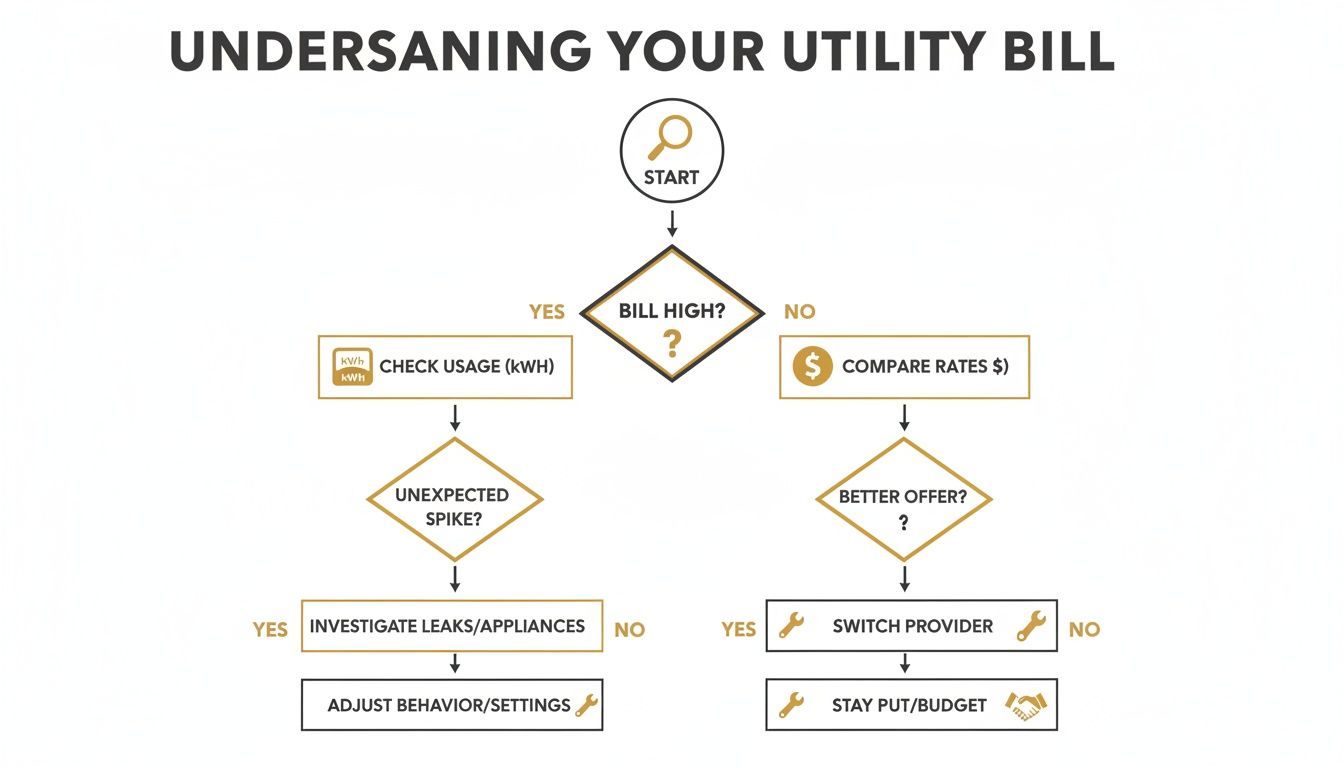
As the flowchart shows, your first move should always be to analyze your own usage patterns and get a handle on your utility's rate structure before you start looking for other causes.
Your Room-by-Room Energy Audit Checklist
Doing a simple energy audit yourself can turn these abstract ideas into something you can actually see and fix. Grab a notepad, walk through your home, and start looking for these specific energy drains. This little exercise is the best way to see where your money is really going.
Living Room & Bedrooms
- Check Electronics: Are the TV, sound system, and game consoles plugged into a power strip you can easily switch off? If not, they’re costing you money.
- Inspect Windows and Doors: Feel for drafts around the edges. A poorly sealed door might as well be an open window, forcing your furnace or AC to work overtime.
- Mind the Lights: Still using old-school incandescent bulbs? Swapping them for LEDs is one of the quickest, cheapest ways to cut your lighting costs down to size.
Kitchen & Laundry Room
- Appliance Age: How old is that fridge? Anything over 10 years old is a notorious power hog.
- Phantom Loads: Unplug the coffee maker, toaster, and microwave when you're not using them. Every little bit helps.
- Water Heater Settings: Check the dial on your water heater. It should be set to 120°F. Any higher is just wasting energy to keep water scalding hot.
By identifying these energy hogs, you can start taking targeted action. To go deeper, you can learn more about how to improve home energy efficiency in our detailed guide. The goal is simple: stop paying for wasted energy and start putting that money toward a more comfortable, affordable home.
How Your Windows Drive Up Winter Heating Costs
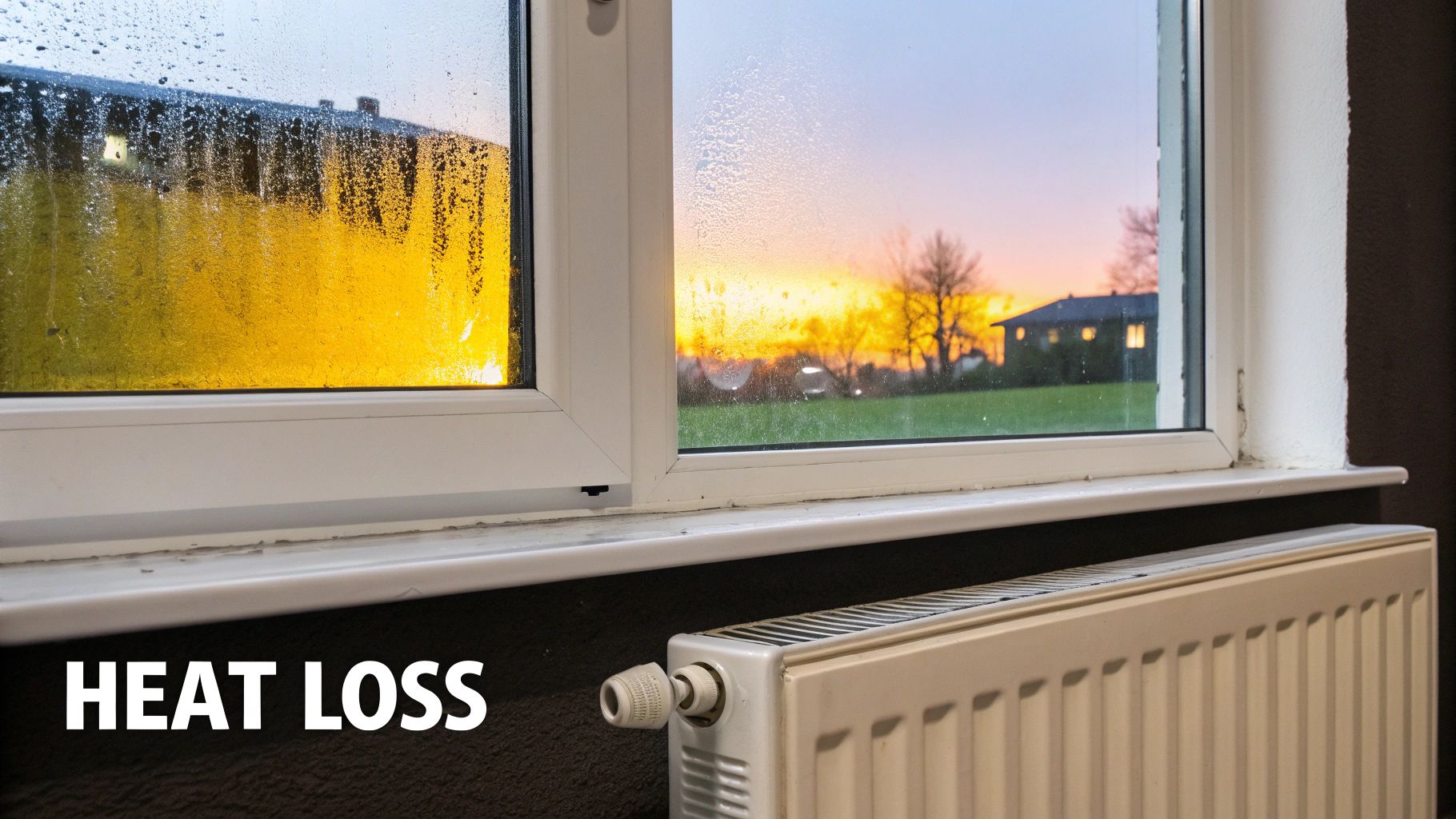
When you get that bill and ask, "why is my electric bill so high," your windows are often a prime suspect—especially during a chilly Chattanooga winter. We usually think about windows letting summer heat in, but they're just as guilty of letting your expensive heat out when the temperature drops.
Think of a standard, untreated window as a thermal hole in your wall. Glass is a terrible insulator. It transfers heat incredibly well, which is the last thing you want. All that cozy, expensive warmth your furnace is pumping out is drawn right to the cold glass and escapes outside.
This puts your heating system into a nonstop cycle. It has to run longer and more often just to replace the heat that’s leaking out, fighting a losing battle to keep you comfortable. It’s like trying to warm up your car on a freezing day with the windows cracked—you’re just burning fuel for nothing.
The Science of Winter Heat Loss
This constant energy drain happens through a process called thermal convection. Warm air inside your home circulates, hits the cold surface of your window, cools down, and sinks to the floor. This is what creates those uncomfortable drafts and cold spots, signaling your thermostat to kick the heat on yet again.
It's a huge financial drain. The Department of Energy estimates that heat loss through windows is responsible for 25%–30% of a home's heating energy use. For business owners here in the Chattanooga area, that can be a massive slice of the operating budget.
This constant energy transfer hits your wallet hard, making your home or business less comfortable and way more expensive to run. The good news? You don't have to live with these invisible leaks.
An Insulating Barrier for Your Glass
The smartest way to stop this winter heat loss without a full window replacement is to add a high-performance insulating layer right onto your existing glass. Modern window films are engineered specifically to act as a thermal barrier.
Unlike the dark tints of the past, today's advanced films work by reflecting your indoor heat back into the room. This technology essentially upgrades your windows, dramatically improving their insulating power and keeping the warmth right where you want it.
This insulating effect brings immediate benefits for homeowners and businesses in our service radius around Chattanooga:
- Less HVAC Runtime: By holding onto your indoor heat, the film eases the load on your furnace. It will cycle off more often and run for shorter periods.
- No More Cold Spots: The film keeps the interior glass surface warmer, cutting down on those nasty drafts and creating a more even, comfortable temperature.
- Lower Energy Bills: When your furnace works less, it uses less energy. That translates directly to smaller numbers on your monthly utility bill.
By turning your windows from energy liabilities into energy assets, you get a more comfortable and cost-efficient property all year round. You can learn more about how to achieve major savings with professionally installed window films for energy savings.
Energy Performance of Untreated Glass vs Tinted Windows
The table below paints a clear picture of just how much of a difference the right window film can make.
| Performance Metric | Standard Dual-Pane Window | Window with Solar Sentinel Film |
|---|---|---|
| Winter Heat Retention | Poor; allows significant heat to escape. | Excellent; reflects indoor heat back into the room. |
| Summer Heat Rejection | Limited; allows solar heat to enter freely. | Superior; blocks up to 93% of solar heat. |
| HVAC System Strain | High; system runs constantly to compensate for loss/gain. | Low; system runs less, saving energy and wear. |
| Comfort Level | Inconsistent; creates hot and cold spots near windows. | Consistent; maintains a stable temperature year-round. |
Ultimately, treating your windows is one of the most effective upgrades you can make to tackle a high electric bill. It stops the constant energy drain at its source, delivering immediate comfort and long-term financial returns for your home or business.
The Year-Round Solution for Lower Energy Bills
After seeing just how much untreated windows can bleed away your hard-earned money, especially during our cold Tennessee winters, the next logical question is: what’s the smartest way to fix it? You could go through the massive, costly project of replacing all your windows. Or, you could get powerful results for a fraction of the cost with a more modern solution—advanced window film.
For many folks in the Chattanooga area, the term "window tint" is still something they need more education on. The technology we use for residential homes and commercial buildings is a world away from what you might imagine. Today’s professional films are engineered with sophisticated nano-ceramic technology, making them virtually invisible while providing incredible insulating power.
This isn’t just about blocking the brutal summer sun, either. As we head into the winter, these films play a critical role in keeping your heating costs down. They act as a powerful thermal barrier, reflecting your home’s indoor heat right back into the room instead of letting it escape through the glass. This simple act of retaining warmth can be a total game-changer when you're staring at your utility statement wondering, "why is my electric bill so high?"
How Modern Window Film Works in Winter
Think of advanced window film as an invisible winter coat for your glass. It significantly boosts the insulating performance of your existing windows, which is a huge deal for properties all over our 45-60 mile service radius around Chattanooga.
The result? A dramatic reduction in the workload on your furnace or heat pump. By retaining up to 40% more indoor heat, the film helps your HVAC system run less often and for shorter cycles. That means you use less energy to stay comfortable, which directly lowers your monthly bills.
This technology addresses one of the core reasons for a high electric bill year-round. In summer, it rejects solar heat to keep you cool. In winter, it locks in warmth to keep you cozy. It's a single upgrade that works 365 days a year to save you money.
For commercial properties here in Chattanooga—from downtown offices to local storefronts—this translates into serious operational cost savings and a much more comfortable environment for employees and customers.
More Than Just Energy Savings
While the impact on your electric bill is huge, the benefits don't stop there. Professionally installed window films offer a whole suite of advantages for your home or business.
- Preserve Your Views: Unlike old, dark tints, modern nano-ceramic films are designed for optical clarity. You can enjoy your beautiful Tennessee views without sacrificing performance.
- Protect Your Interiors: The film blocks 99% of harmful UV rays, which is the main cause of fading. This protects your hardwood floors, furniture, artwork, and merchandise from sun damage.
- Reduce Glare: Whether it’s on a TV screen at home or a computer monitor at the office, our films cut down on that frustrating glare, making your spaces more functional and comfortable.
To get even more precise control over your heating and cooling, consider pairing window film with a smart thermostat. Effective smart thermostat installations create a highly efficient home comfort system that maximizes your savings. By tackling energy loss at the windows and optimizing your thermostat's performance, you create a powerful one-two punch against high energy bills.
Got Questions? We've Got Answers.
Even after seeing what's driving up your power bill, it's smart to have a few questions before you invest in a fix like window film. For homeowners and business owners right here in Chattanooga, making the right call is what leads to real, lasting savings.
We hear the same great questions from folks all the time. Here are some of the most common ones, with honest, straightforward answers to help you see just how practical this energy-saving upgrade is.
Will Window Film Make My Home Too Dark in the Winter?
This is easily one of the biggest worries we hear, especially when the shorter, cloudier days of a Tennessee winter roll in. Nobody wants to solve a heat problem just to create a light problem.
But modern residential and commercial window film isn't the dark, bubbly tint you might be picturing. The nano-ceramic films we use are engineered to be incredibly smart. They can tell the difference between the light you want and the energy you don't.
Think of it like this: they block a massive amount of infrared light (that’s the heat you feel) and almost all the UV rays (the ones that fade your floors), but they let the good stuff—visible light—stream right through. You get a powerful insulating shield that keeps your home warmer without turning your living room into a cave. We even have different films so you can pick the perfect balance of brightness and performance for your space.
How Much Can I Really Save Here in Chattanooga?
Every home and business is a little different, of course. The number of windows you have, which way your building faces, and your current utility rates all factor in. But the potential savings are absolutely real.
The main job of window film is to take the pressure off your HVAC system, which is the biggest energy hog in any building.
By acting as a tough thermal barrier, our films can cut your total heating and cooling costs by as much as 40%. In the summer, the film rejects the brutal solar heat. In our chilly winters, it does the exact opposite, bouncing your furnace’s heat back into the room instead of letting it leak out through the glass.
For a typical Chattanooga home, that steady, year-round performance adds up to serious savings, month after month. Before you know it, the window film has paid for itself in lower power bills—all while you get to enjoy a much more comfortable home.
Is Film a Better Deal Than Replacing My Windows?
For almost everyone we talk to, the answer is a big, flashing YES.
Replacing all your windows is a massive project. It’s messy, disruptive, and can easily cost you tens of thousands of dollars. While new windows are more efficient than old ones, it’s a huge expense with a payback period that can stretch on for decades.
Professionally installed residential or commercial window film, on the other hand, gives you similar (and sometimes even better) solar control and insulation for just a tiny fraction of that cost. The installation is clean, quick, and won't turn your life or business upside down.
Best of all, you start getting a return on your investment almost immediately. You'll feel the difference in comfort right away, and you’ll see the proof on your very next energy bill. If your window frames are in good shape, adding high-performance film is hands-down the most cost-effective energy upgrade you can make.
Can You Install Film on My Business Without Changing How It Looks?
Absolutely. This is a huge part of what we do for businesses all over the Chattanooga area. We know that maintaining your building's look—whether it's a downtown storefront, a restaurant, or an office in a historic building—is completely non-negotiable.
We carry a range of films that are practically invisible but still pack a serious performance punch. They're perfect for commercial buildings because they:
- Block Heat & UV Rays: Slashes cooling costs and protects your expensive merchandise, furniture, and flooring from sun damage.
- Cut Annoying Glare: Makes employees and customers happier by getting rid of the harsh glare on computer screens and displays.
- Improve Comfort: Keeps the indoor temperature stable and pleasant, making the whole space more inviting.
You get all these benefits without changing the look of your building one bit. It’s an invisible upgrade that delivers very visible results to your bottom line and your customers' comfort.
Tired of sky-high energy bills and a space that’s never the right temperature? The team at Solar Sentinel Window Films & Tinting can help you get comfortable fast and save money for years to come. Contact us today for a free, no-obligation consultation and see what a difference professional window film can make for your Chattanooga-area property.
